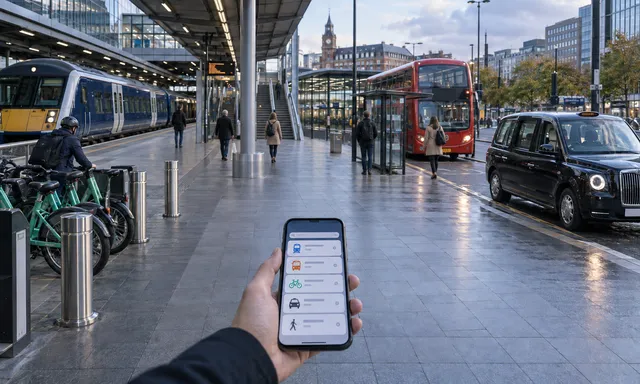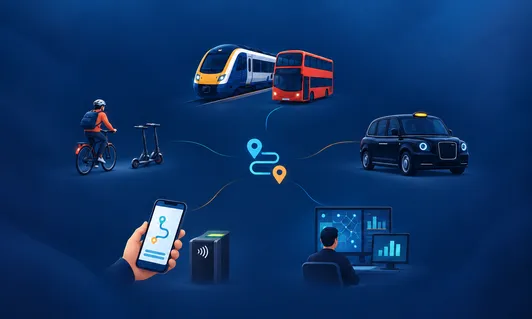
The passenger mobility industry is the ecosystem of organisations responsible for enabling passenger movement. It includes traditional public transport alongside shared and on-demand services, passenger platforms, mobility software, autonomous and emerging transport technologies and the authorities and specialist organisations responsible for planning and improving how people move.
What Does the Mobility Industry Include?
At its simplest, the mobility industry exists to enable people to make journeys. That becomes more complicated when you look at everything required to make even an ordinary passenger journey possible.
Imagine someone travelling to work. They might use a shared bike to reach a railway station, buy a ticket through a digital platform, travel by train and use real-time passenger information to connect with a bus at the other end. To the passenger, that is one journey. Behind it could be a micromobility operator, railway company, bus operator, infrastructure organisation, ticketing provider, journey-planning platform, payment system, mobility software company and transport authority, each playing a different role in enabling the same journey.
The Main Sectors of the Mobility Industry
There is no single universally accepted way of dividing the mobility industry. For understanding passenger mobility, it is useful to separate organisations according to their defining proposition within passenger mobility rather than treating transport modes, technologies and industry trends as interchangeable categories. At MobilityTalent, we group the passenger mobility industry into eight broad sectors.
Public Transport Systems
Public Transport Systems covers organisations operating established collective passenger services, including rail, metro, tram, bus and bus rapid transit networks. These are the physical transport systems at the centre of much of passenger mobility. They move large numbers of people through scheduled or structured services and depend on substantial infrastructure, engineering and operational capability. Newer technologies increasingly connect with these networks, but public transport remains one of the foundations of the wider industry.
Shared & On-Demand Mobility
Shared & On-Demand Mobility covers passenger services that provide access to transport without requiring the user to own the vehicle or depend entirely on traditional fixed-route services. Ride-hailing, ride pooling, car sharing, demand-responsive transport and shared shuttle services can all sit within this sector. Many combine physical operations with digital platforms that match passengers with vehicles or services in real time.
Micromobility & Active Travel
Micromobility covers shorter-distance forms of passenger movement including cycling, walking, shared bikes, e-bikes and e-scooters, alongside the systems and infrastructure supporting them. These modes can provide complete short journeys or connect passengers with larger public transport networks. Their role is particularly visible in first-mile and last-mile travel, where a short bike, scooter or walking journey can determine how easily someone reaches a station or other transport connection.
Future Mobility
Future Mobility covers emerging passenger transport systems that sit beyond today's established transport modes. This can include advanced air mobility, new automated transit systems and other passenger transport concepts introducing different ways of moving people. The category is deliberately distinct from technologies simply improving existing transport. Many future mobility concepts involve new vehicles, operating models or infrastructure and remain at different stages of technical, regulatory and commercial maturity.
Passenger Mobility Platforms
Passenger Mobility Platforms provide the digital layer through which people discover, compare, plan, book, access or pay for journeys. Journey-planning applications, digital ticketing and payment platforms, multimodal services and Mobility as a Service products can all sit within this sector. These companies demonstrate an important feature of modern passenger mobility: an organisation can play a significant role in the passenger journey without owning the infrastructure or operating the vehicle. The key distinction is that Passenger Mobility Platforms are primarily concerned with how passengers access and interact with transport services.
Connected & Automated Mobility
Connected & Automated Mobility covers technologies that change how passenger vehicles perceive their surroundings, communicate and operate. This includes autonomous driving systems, robotaxis, autonomous shuttles, connected vehicle technologies and the supporting software, simulation, mapping and safety systems required to develop and deploy them. The sector brings together transport expertise with software engineering, artificial intelligence, robotics, vehicle systems and safety. Unlike Future Mobility, the defining feature here that the autonomous or connected technology is operational rather than part of the development ofan entirely new transport mode.
Mobility Software & Intelligence
Mobility Software & Intelligence covers the technology used by operators, authorities and other organisations to plan, manage, model and improve passenger transport. This can include scheduling, routing and optimisation, fleet and operational management, transport planning software, passenger information, simulation, forecasting and mobility analytics. Companies such as CitySwift, Tracsis, Basemap and Autocab illustrate how specialist technology businesses help operators and authorities plan, manage and improve passenger transport. The distinction from Passenger Mobility Platforms is useful: Passenger Mobility Platforms primarily help people access and navigate journeys, while Mobility Software & Intelligence primarily helps organisations operate, understand and improve transport systems.
Transport Authority & Advisory
Transport Authority & Advisory covers organisations involved in planning, governing, regulating, funding or strategically shaping passenger transport. This can include transport authorities, government bodies, regulators and specialist organisations supporting transport planning, policy and strategy. These organisations may not physically move passengers, but they can determine how networks are designed, commissioned, funded and developed. Their inclusion reflects an important feature of passenger mobility: the industry is shaped not only by companies selling transport services, but also by the institutions responsible for how those services fit together.
Mobility vs Transport: What's the Difference?
Transport traditionally focuses on the vehicles, infrastructure and services used to move people or goods. Passenger mobility describes the wider, increasingly technology-driven system around that movement, digital ticketing, real-time information, data and AI are reshaping how passenger transport is planned and experienced, spanning platforms and the convergence of previously separate sectors. In practice, industry terminology remains inconsistent, and neither term replaces the other. For a full explanation of how the language is evolving, see From Transport to Mobility.
What Isn't Part of the Passenger Mobility Industry?
Not every organisation connected with vehicles or transportation automatically belongs within passenger mobility. Freight and logistics primarily concern the movement of goods. A general software company does not become a mobility company simply because one customer operates buses. Likewise, a consultancy with occasional transport work is not necessarily a specialist passenger mobility organisation.
A useful test is simple: what role does this organisation play in enabling passenger movement? If the connection is incidental rather than central to what the organisation does, it is better viewed as adjacent to the industry rather than part of its core.
Careers Across the Passenger Mobility Industry
There is no single ‘mobility career.’ A railway operator, autonomous technology company, passenger platform and transport authority can all belong to the same wider industry while requiring very different skills and most professionals enter through a specific discipline e.g railway engineering, transport planning, software development or project management, rather than deciding to work in ‘mobility’ from the outset.
Understanding how the sectors connect makes that experience easier to transfer. A data specialist at public transport operator may have relevant experience for a software company whereas someone in ticketing could move between an operator, another mobility technology supplier or a transport authority. Skills don't transfer automatically, different organisations have their own technical requirements and regulations but understanding the connections helps professionals identify adjacent employers and interpret job titles that vary depending on whether the employer is an operator, authority, software business or emerging transport company, rather than limiting a search to the organisations they already recognise.
Where to Find Passenger Mobility Jobs
Passenger mobility has a fragmented employer landscape. Relevant roles are spread across all eight sectors above, so searching only the largest transport employers can leave substantial parts of the market unseen. General job boards can help, but sector-specific searching makes it easier to identify opportunities and understand how your experience might transfer between them.
Explore Opportunities Across Passenger Mobility
Passenger mobility connects Public Transport Systems and Shared & On-Demand Mobility with Passenger Mobility Platforms, Mobility Software & Intelligence, Connected & Autonomous Mobility and the Transport Authority & Advisory organisations shaping how transport systems work. Seeing where your own experience fits often means looking beyond the employers you already recognise.
Browse current jobs on MobilityTalent to explore professional roles across the passenger mobility industry, or join the MobilityTalent community to stay connected with hiring trends and new roles as they're posted.
Frequently Asked Questions
What is the mobility industry?
The mobility industry is the ecosystem of organisations, technologies and public bodies involved in enabling passenger movement. It spans public transport, shared and on-demand services, digital platforms, software and the authorities that plan and regulate how people travel, rather than any single transport mode.
What sectors are included in the mobility industry?
MobilityTalent groups passenger mobility into eight sectors: Public Transport Systems, Shared & On-Demand Mobility, Active & Micromobility, Passenger Mobility Platforms, Autonomous & Connected Mobility, Mobility Software & Intelligence, Transport Authority & Advisory, and Future Mobility. Organisations often operate across more than one area, but these categories offer a practical way to understand their different roles.
What is the difference between mobility and transport?
Transport generally refers to the vehicles, infrastructure and services used to move people or goods. Passenger mobility is used more broadly, covering how people access and complete journeys, including the technologies and platforms connecting different transport options. The terminology is not always used consistently across the industry.
Is public transport part of the mobility industry?
Yes. Public Transport Systems is one of the foundations of passenger mobility and includes rail, metro, tram, bus and other collective passenger services. Newer technologies and business models have expanded the ecosystem around these networks, but established public transport remains central to how large numbers of people move.
Do I need transport experience to work in passenger mobility?
Not necessarily. Specialist engineering, operational and safety-critical positions may require sector-specific experience or qualifications, but transferable skills can be relevant across software, data, project management, product, commercial, strategy and corporate functions. The requirements depend heavily on the organisation, sector and individual role.